
Why VR Replayability Fails (and What Actually Works)
Many VR games lose players after one session. Here’s why replayability breaks—and how missions, modifiers, and leaderboards create repeat intent.
1) The “One-and-Done” Trap: When VR Feels Like a Demo
Most vr-gaming drop-off isn’t because players dislike VR—it’s because many titles stop giving them reasons to come back. The common pattern is a strong first 10 minutes followed by a shallow loop: a single mechanic, a few set-piece moments, and then nothing that reframes the experience on session two. Without clear goals, players don’t know what “good” looks like, and without mastery targets, there’s no reason to improve. That’s a game-design problem, not a marketing one.
The second failure is friction. If movement feels uncomfortable, UI is hard to read in-headset, or calibration takes too long, the player’s next-session cost is too high. This hits even harder for new users sharing a headset, and it’s brutal in venues where operators need quick turnover. When onboarding and locomotion aren’t “comfort-first,” player-retention suffers regardless of production value.
Finally, replayability collapses when a game lacks visible progress—no meaningful unlocks, no evolving tools, and no social comparison. In practice, the absence of progression-systems and leaderboards turns “I tried it” into “I’m done.”
2) What Actually Drives Repeat Play: Mastery, Missions, and Meaningful Change

Replayable vr-gaming isn’t about being “long”—it’s about being return-friendly. The most reliable driver is score mastery: time trials, accuracy, combo systems, and clear grading that tell players exactly what to chase next. Pair that with short, repeatable missions (5–10 minutes) and you get a natural rhythm: finish, evaluate, re-queue. This is where leaderboards shine, because they convert self-improvement into social competition without requiring a full multiplayer lobby.
The next driver is meaningful variation. Unlocks should change decisions, not just cosmetics: new tools, modifiers, and loadout tradeoffs that reshape strategies across the same mission set. Done right, your core content stays stable while the player’s approach evolves—textbook progression-systems that increase depth without increasing onboarding time.
Finally, comfort-first design is a replay multiplier. A 2–3 minute setup that locks in seated/standing mode and locomotion options reduces drop-off and makes the “second session” feel effortless. For OpenXR ecosystems, supporting boundary systems and controller/hand tracking lets comfort and accessibility scale across headsets—good game-design that directly improves player-retention.
3) Measuring “Repeat Intent” (and Designing for Home + Venue Reality)
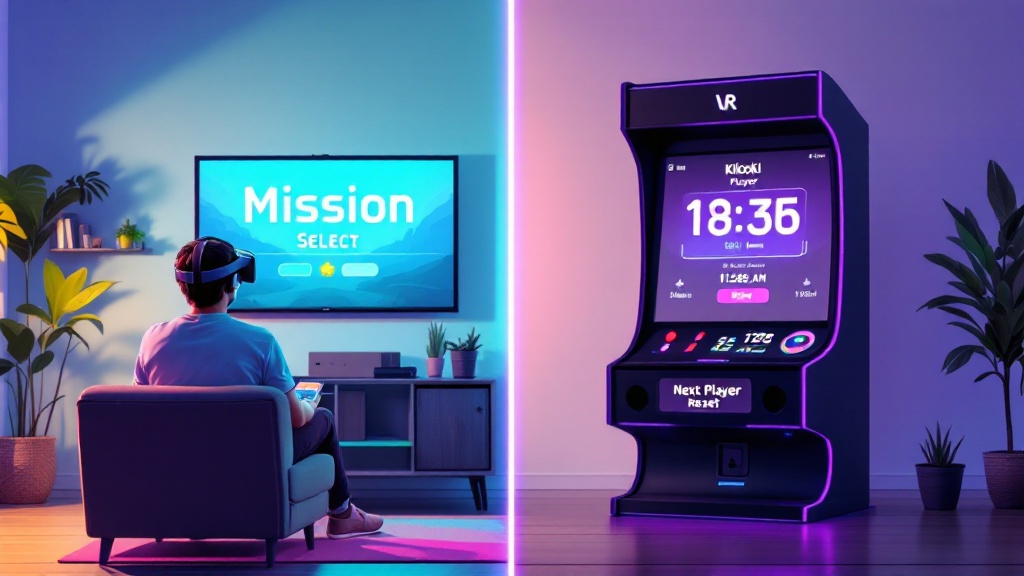
To build replayability, measure more than raw playtime. “Repeat intent” shows up in behaviors: tutorial completion rate, time-to-first-mission, number of retries per mission, and whether players change comfort settings (a signal they’re trying to make the game sustainable). Track D1/D7 return rates, but also look at session shape: do players do one long session and churn, or several short sessions over multiple days? In vr-gaming, the second pattern usually signals durable player-retention.
For venues, add operational metrics: average reset time, menu dwell time between players, and completion rate per session. A kiosk mode that auto-resets, re-centers quickly, and guides new users through a minimal comfort onboarding removes the biggest barrier to repeat revenue. Leaderboards can be venue-specific (daily highs, local “top 10”) to keep walk-ins competing even with short sessions.
This is the design space PresenceArc Games is targeting with a VR-native, mission-based title: comfort-first locomotion, fast onboarding, and a progression loop built for both home headsets and arcade operations. It’s a practical game-design path where progression-systems and score mastery are not extras—they’re the product.